
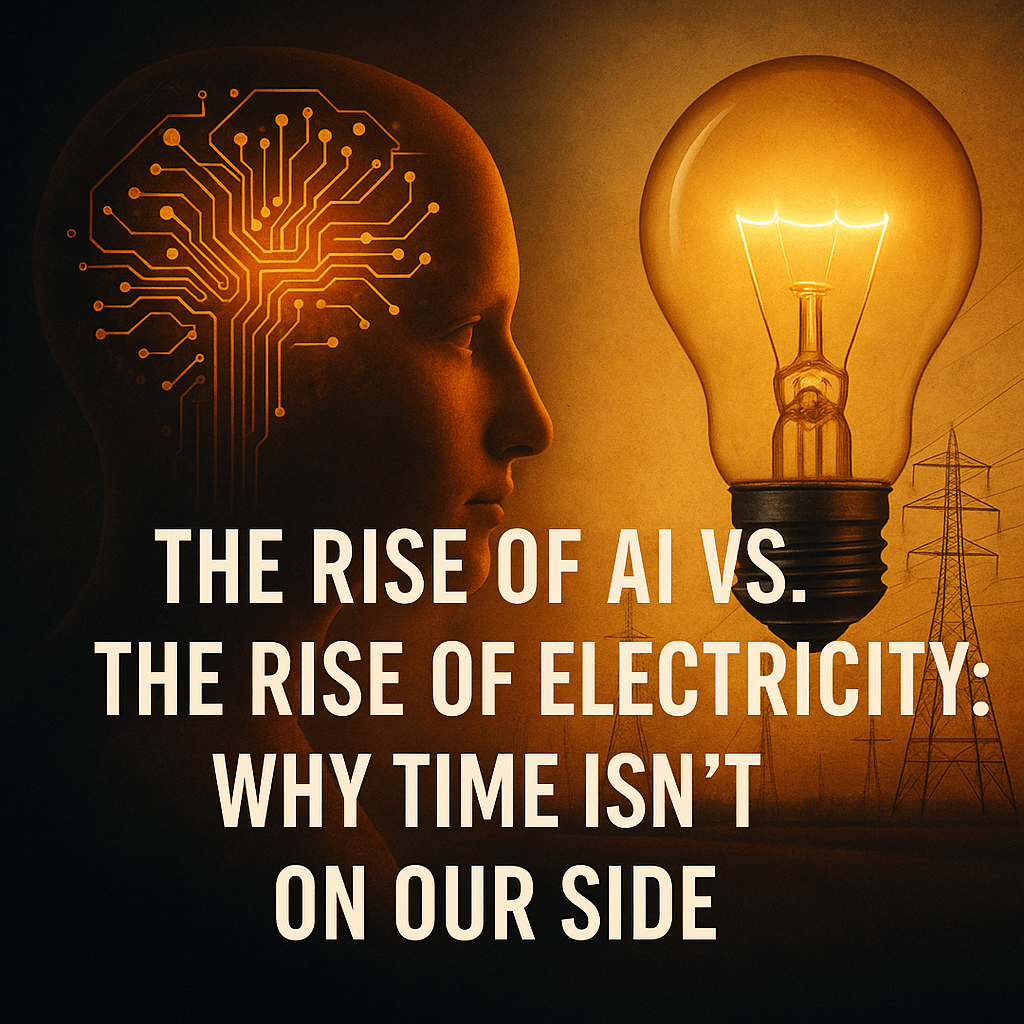
When people search for historical parallels to artificial intelligence, electricity is often the most compelling comparison. Both are general-purpose technologies capable of reshaping every industry, every household, and every human experience. But while electricity took decades to diffuse into society, AI is moving at breakneck speed — giving us little room to pause, adapt, or even fully understand what’s happening.
The Rise of Electricity
Electricity’s story began in the late 19th century. Thomas Edison opened the Pearl Street Station in New York in 1882, marking one of the first commercial power plants. Yet even with such innovation, it took nearly 50 years before electricity became a mainstream utility in American homes and industries.
- Slow diffusion: Rural electrification didn’t occur until the 1930s–40s, leaving many communities without power for decades.
- Time to adapt: Business leaders, workers, and governments had years to restructure industries, create regulations, and redesign daily life around this new force.
- Incremental impact: Electricity’s full economic and social transformation unfolded gradually — from factories to lighting to household appliances — giving society breathing room to adapt, retrain, and reorganize.
In short: electricity changed everything, but it gave humanity time to grow with it.
How People Saw Electricity Then
It’s easy to assume electricity was welcomed with open arms, but in reality it was met with awe, skepticism, and even fear.
- Fear of danger: Newspapers ran stories of fires, electrocutions, and accidents. Some saw electricity as an unpredictable and deadly force.
- Skepticism of need: Rural families questioned why they needed electric light when kerosene lamps “worked just fine.” To many, electricity seemed like a luxury, not a necessity.
- Wonder and spectacle: Public demonstrations — from Edison’s lightbulbs to Tesla’s sparks — captivated crowds. People were both thrilled and unsettled by the invisible power that could light up entire cities.
- Slow acceptance: Trust took decades to build. Electricity had to prove itself safe, useful, and worth the disruption before becoming indispensable.
This hesitation gave society something invaluable: time to adapt.
The Rise of AI
Artificial intelligence is different. Although the field dates back to the 1950s, the tipping point came only recently with breakthroughs in large language models, computer vision, and generative AI. In less than five years, we’ve seen AI leap from niche labs to everyday tools that write, design, code, analyze, and even make strategic decisions.
- Rapid diffusion: Within months of launch, tools like ChatGPT reached over 100 million users — faster adoption than any prior technology in history.
- No adaptation period: Entire industries — law, medicine, education, marketing, transportation — are being disrupted simultaneously. Workers aren’t retraining over decades; they’re being displaced within quarters.
- Exponential progress: Unlike electricity, AI builds on itself. Each improvement accelerates the next. We don’t just get linear growth; we get compounding capability.
AI is not trickling into society — it’s flooding in.
What People Are Saying About AI
Public sentiment around AI is complex — hopeful, anxious, confused. Below are what folks are saying now, whether experts, everyday people, tech leaders, or ethicists.
Public Concerns & Worries
- Jobs & displacement: Many people fear AI will take over jobs — not just manual labor, but white-collar work: legal, finance, consulting. Experts warn that entry-level roles are especially vulnerable.
- False or misleading information: There’s widespread concern about AI generating misinformation, impersonation, deepfakes, hallucinations (when AI confidently presents false info as fact). Both experts and laypeople are saying: “How reliable is this?”
- Loss of human connection / erosion of skills: People worry AI will erode relationships, reduce creativity, weaken personal decision-making. Some say they already feel over-reliant on AI for choices and guidance.
- Ethical and moral risks: Questions about bias, fairness, privacy, control, and malicious use are front and center. Who is controlling the data? Who decides which values are encoded in AI systems? Religious, ethical bodies are also weighing in.
Hope, Promise, & Optimism
- Efficiency, problem-solving, breakthroughs: Many see AI as a powerful tool for solving big problems — faster medical diagnostics, efficient logistics, climate modeling, unlocking creative tools. People who use AI often see benefits.
- Innovation & competitive edge: Business leaders and policy makers view AI as essential to remain competitive, especially globally. The U.S. vs. China race, leadership in AI adoption — those are frequently mentioned.
- Regulation & oversight: Because many people feel uneasy, there’s strong demand for guardrails: legislation, transparency, ethics boards, international cooperation.
Voices to Note (Quotes & Experts)
Geoffrey Hinton, often called one of the “godfathers” of modern AI, has said his fear is that AI will eventually be a form of intelligence “just better than people… We’d no longer be needed.”
- The co-founders of Anthropic warn that AI might replace up to 50% of entry-level office jobs in law, finance, and consulting in the near future.
- From a Pew Research survey: 66% of U.S. adults are very worried about AI generating false or misleading information.
The Tension: Promise vs. Fear
What’s striking is that people also see real upside — not black or white. Most want AI to be useful, powerful, beneficial — but they want control, safety, ethics. Unlike electricity, where people thought more in terms of danger or wonder but had fewer concrete fears about privacy, bias, or existential risk, contemporary concerns are sharper, more multidimensional.
Why We Don’t Have the Luxury of Time
The contrast is stark:
- Electricity gave us half a century to build infrastructure, regulate safety, and retrain the workforce.
- AI is transforming every sector in less than half a decade, with no clear roadmap, no universal regulation, and a global arms race driving faster adoption.
That lack of time is the crux of the challenge. Businesses, governments, and individuals can’t treat AI as a distant horizon. It’s already here, shaping competitive advantage, political power, and economic structures in real time.
The Urgency of Now
Electricity taught us that once a general-purpose technology takes hold, it redefines the world. AI is doing the same — but in hyper-speed. The question isn’t whether society will adapt, but whether we can adapt fast enough.
For businesses, this means building AI literacy immediately. For governments, it means balancing innovation with safeguards before the gap between regulation and reality becomes unmanageable. For individuals, it means reskilling, reframing, and rethinking career paths now, not later.
Bottom line: Electricity changed the world, but it gave us decades to catch up. AI is changing the world too — only this time, the clock is already running, and the window to adapt is closing fast.
 chamberu.blog
Leave a comment