
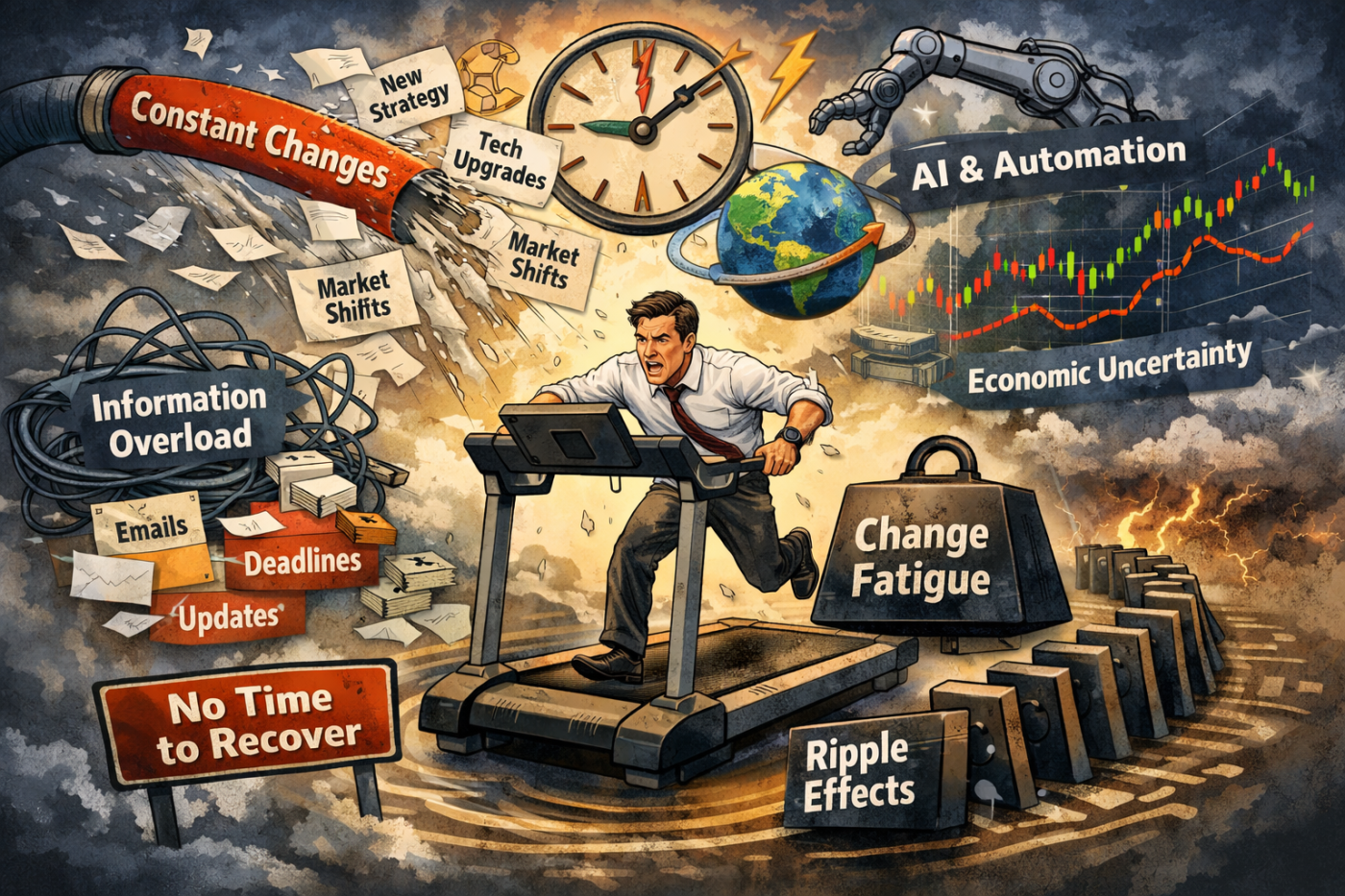
If it feels like you’re sprinting just to stay in the same place, you’re not imagining things.
Change has always been part of work and life. New strategies. New tools. New priorities. That’s not the problem.
The problem is that change no longer shows up one guest at a time. It arrives as a crowd, pushes past the furniture, and never really leaves.
What used to feel like a project now feels like a permanent condition.
Change Isn’t New. The Volume Is.
Think back a decade or two. Change came in waves. You braced for it, adapted, recovered, and moved on. There was a beginning, a middle, and an end.
Today, it’s more like standing under a firehose.
Multiple initiatives roll out at once. Before you’ve figured out one system, another replaces it. Before a strategy settles, it pivots. The calendar fills, the inbox explodes, and the message is always the same: move faster.
It’s not that you’ve gotten worse at adapting. The environment has gotten louder.
Speed Without Recovery Is a Recipe for Burnout
One of the biggest shifts is speed. Change doesn’t just happen faster. It never pauses.
There’s no decompression time. No moment to say, “Okay, we learned that. What worked? What didn’t?” Instead, it’s straight into the next thing.
Imagine running interval sprints with no rest periods. Eventually, even the fittest athlete collapses. Not because they’re weak, but because recovery is part of performance.
Organizations forgot that part.
Everything Is Connected Now
Another reason change feels heavier is that nothing changes in isolation anymore.
A new strategy affects technology. Technology affects workflows. Workflows affect culture. Culture affects morale. Morale affects results.
Pull one thread and the whole system shifts.
So when something goes wrong, it’s not a small correction. It’s a ripple effect. And people feel that pressure in every direction at once.
Control Has Left the Building
There’s also a quieter, more unsettling shift happening.
A lot of today’s change isn’t coming from inside the organization at all. It’s coming from outside forces no one fully controls: technology leaps, market swings, global events, AI, economic uncertainty.
When change is internally driven, leaders can explain it, sequence it, and pace it. When it’s externally driven, everyone is reacting at the same time.
That loss of control is exhausting.
Your Brain Is Doing Exactly What It’s Designed to Do
Here’s the part that matters most.
Humans are wired for pattern recognition and predictability. We like knowing what comes next. When the ground keeps moving, the brain stays in a low-grade stress response.
Add information overload, constant decision-making, and high accountability, and you get what many people are experiencing right now: change fatigue.
Not resistance. Fatigue.
That distinction matters.
The Real Issue Isn’t Change. It’s How We’re Asking People to Carry It.
Most conversations about change focus on resilience. Adaptability. Grit.
Those things matter. But telling people to “be more resilient” without changing the environment is like telling someone to lift heavier weights while cutting their oxygen.
At some point, the system needs to change too.
That means fewer overlapping initiatives. Clearer priorities. Slower pacing where possible. And explicit permission to stop, reflect, and recover.
The Takeaway
If keeping up with change feels harder than ever, it’s because it is.
Change today is more constant, more complex, more interconnected, and more out of our direct control than at any point before. That doesn’t mean you’re failing. It means the rules of the game changed.
The path forward isn’t pretending this pace is normal. It’s redesigning how we lead, decide, and sequence change so humans can actually sustain it.
Because adaptation isn’t about endless motion.
It’s about knowing when to move — and when to breathe.
 chamberu.blog
Leave a comment