
From Open Access to Regulated Monopoly
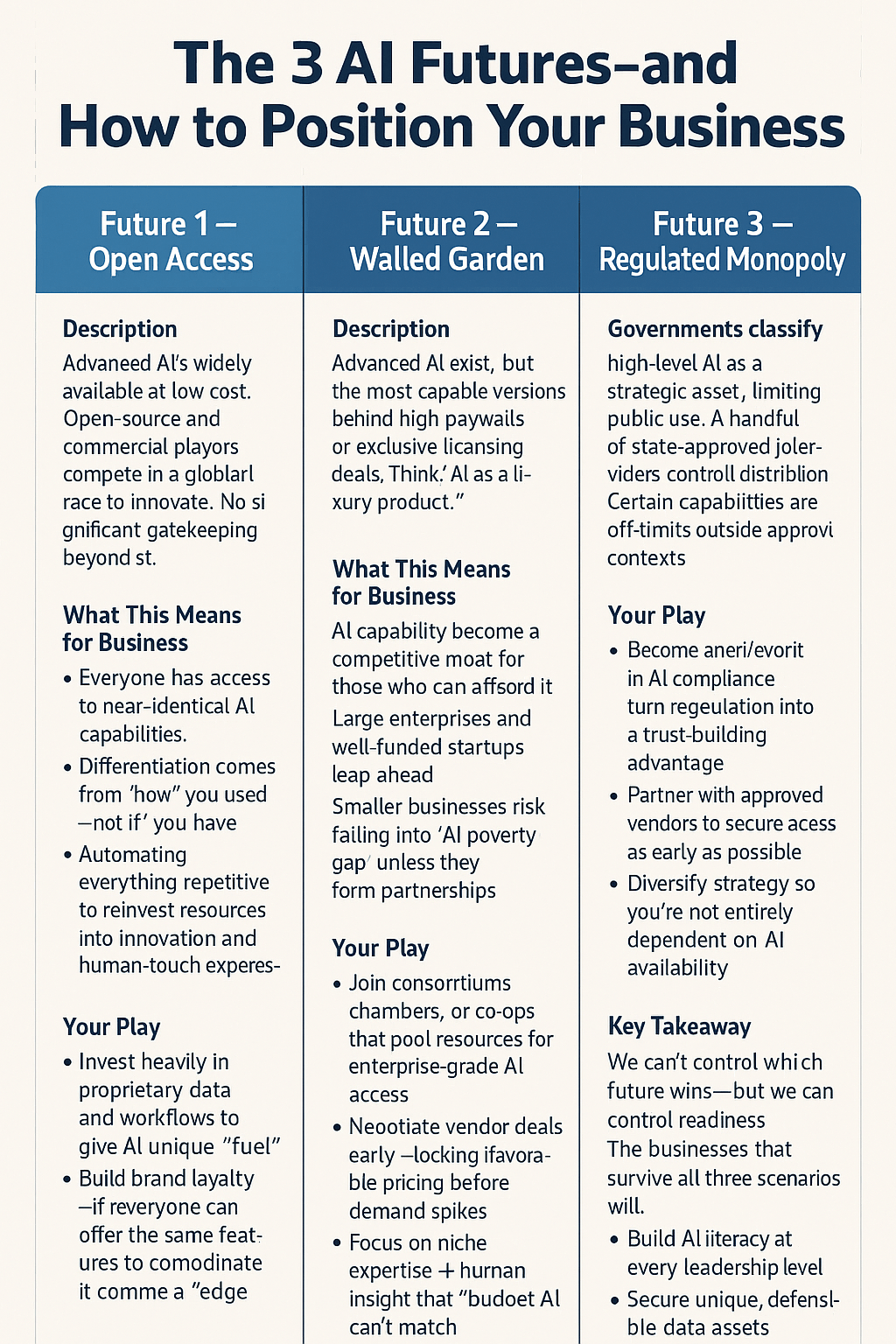
Future 1 — Open Access
Description:
Advanced AI is widely available at low cost. Open-source and commercial players compete in a global race to innovate. No significant gatekeeping beyond standard tech regulations.
What This Means for Business:
Everyone has access to near-identical AI capabilities.
Differentiation comes from how you use AI, not if you have it.
Margins compress in commoditized markets—speed, creativity, and customer experience become your edge.
Your Play:
Invest heavily in proprietary data and workflows to give your AI unique “fuel.”
Build brand loyalty—if everyone can offer the same features, people will buy from those they trust.
Automate everything repetitive to reinvest resources into innovation and human-touch experiences.
Future 2 — Walled Garden
Description:
Advanced AI exists, but the most capable versions are behind high paywalls or exclusive licensing deals. Think “AI as a luxury product.”
What This Means for Business:
AI capability becomes a competitive moat for those who can afford it.
Large enterprises and well-funded startups leap ahead.
Smaller businesses risk falling into the “AI poverty gap” unless they form partnerships.
Your Play:
Join consortiums, chambers, or co-ops that pool resources for enterprise-grade AI access.
Negotiate vendor deals early—locking in favorable pricing now before demand spikes.
Focus on niche expertise + human insight that “budget AI” can’t match.
Future 3 — Regulated Monopoly
Description:
Governments classify high-level AI as a strategic asset, limiting public use. A handful of state-approved providers control distribution, and certain capabilities are off-limits outside approved contexts.
What This Means for Business:
AI adoption is slowed by compliance, licensing, and vetting.
Innovation shifts to compliance-friendly use cases.
Black markets or “AI grey zones” emerge for restricted capabilities.
Your Play:
Become an early expert in AI compliance—turn regulation into a trust-building advantage.
Partner with approved vendors to secure access as early as possible.
Diversify strategy so you’re not entirely dependent on AI availability.
Key Takeaway
We can’t control which future wins—but we can control readiness. The businesses that survive all three scenarios will:
1. Build AI literacy at every leadership level.
2. Secure unique, defensible data assets.
3. Move early on partnerships, compliance, and integration.
The 3 AI Futures—and How to Position Your Business
 chamberu.blog
Leave a comment