
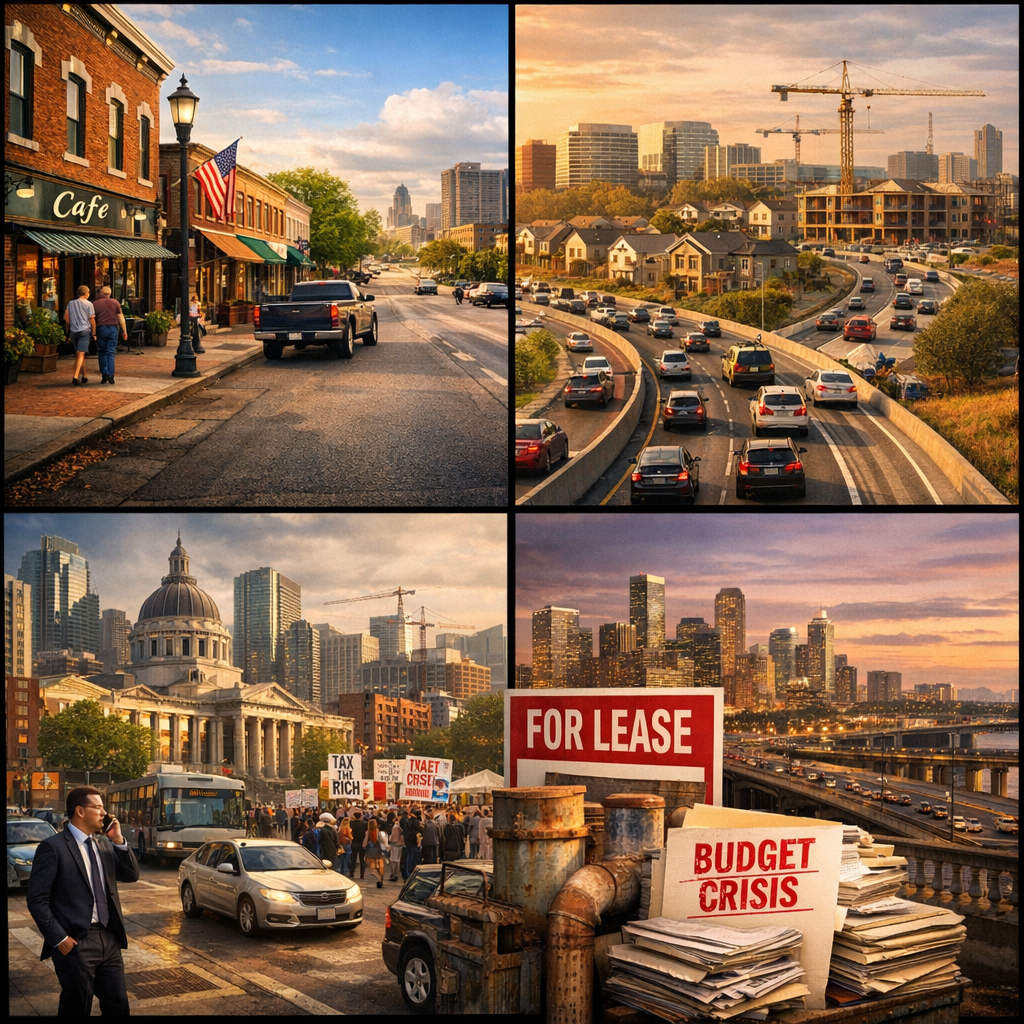
Every community in America follows a growth pattern.
It may take 20 years or 100.
It may move fast or painfully slow.
But the direction is the same.
Small towns become growth markets.
Growth markets become cities.
Cities become systems.
And as this happens, business, politics, and city government do not stay the same.
Neither can you.
The Town Phase: Relationship Economy
Typical Population:
Under ~25,000
In the early stage, business is personal.
Decisions are made face to face.
Trust is currency.
Reputation is leverage.
Government is accessible and service-oriented.
Regulation is light.
Politics is practical.
How Business Wins
- Visibility matters more than scale.
- The owner is the brand.
- Community presence builds revenue.
- Speed and flexibility beat structure.
Miss this, and you enter growth invisible.
The Growth Phase: Competitive Economy
Typical Population:
~25,000 to ~100,000
This is where most disruption happens.
New residents arrive.
Developers move in.
Capital accelerates.
Costs rise.
Rules increase.
Choice expands.
Government professionalizes.
Politics polarizes.
Systems begin to replace relationships.
How Business Wins
- Define your niche clearly.
- Systematize sales and marketing.
- Build a real brand, not just a logo.
- Know your numbers.
- Invest in productivity and technology.
- Stop competing on price. Start competing on value.
Fail here, and you become commoditized.
The City Phase: Systems Economy
Typical Population:
~100,000 to ~300,000
Density changes everything.
Regulation becomes the operating environment.
Labor and real estate become strategic constraints.
Government becomes a major stakeholder.
Politics becomes more ideological.
Institutions gain power.
How Business Wins
- Professionalize operations.
- Build compliance into processes.
- Use data, not instinct.
- Diversify revenue.
- Build government and institutional relationships.
- Manage risk intentionally.
Ignore this, and complexity will crush you.
The Mature City Phase: Strategic Economy
Typical Population:
300,000+
Growth slows, but costs remain.
Margins tighten.
Infrastructure ages.
Debt surfaces.
Talent and capital become selective.
Government focuses on maintaining, not expanding.
Politics protects existing systems.
How Business Wins
- Reposition before decline forces you to.
- Cut unprofitable lines.
- Strengthen pricing discipline.
- Expand into adjacent markets.
- Plan succession and exit early.
- Optimize capital, not just operations.
Delay here, and you become obsolete while staying busy.
The American Pattern
This is not regional.
It is structural.
Across the country, cities evolve.
And as they do, incentives change.
So does power.
So does risk.
The Strategic Truth
Growth is not neutral.
It changes how business operates.
It changes how city government governs.
It changes how politics functions.
The businesses that survive are not the hardest working.
They are the most adaptive.
And the cities that thrive are the ones that grow with intention.
Critical Insight
The most dangerous transition zone is not large cities.
It is the 30,000–120,000 range.
That is where:
- Growth outpaces capacity
- Debt accelerates
- Policy frameworks harden
- And business conditions permanently change.
Cities do not fail when they are small.
They fail when they grow without discipline.
 chamberu.blog
Leave a comment